- Explore the ‘grow your own’ model: in 2026, forward-thinking businesses are moving away from expensive “hire-in” recruitment towards using apprenticeships to upskill existing team members to reduce turnover and recruitment costs.
- Optimise your levy: maximise your payments by tailoring your growth and skills levy strategy to your business needs, by shifting focus towards high-value level 2-5 standards in accounting, HR, law and business administration.
- The hybrid advantage: hybrid apprenticeships for employers, such as Mindful Education’s online and on-campus model, ensures workforce productivity from day one by applying theory directly to the workplace.
- Data-driven ROI: online and on campus apprenticeships offer real-time learner analytics, providing managers with total transparency on training compliance and skill progression.
- Operational agility: roll-on, roll-off training allows organisations to bypass rigid academic calendars and onboard apprentices exactly when the business need arises.
How changing our mindset about apprenticeships can create a future-ready workforce


On this page
At a Glance: Building a Professional Apprenticeship Strategy for 2026
The modern workplace is evolving, and for HR and talent managers, the pressure to attract, retain and develop talent has never been higher. Faced with the challenge of persistent skills shortages and shifting employee expectations, many businesses are moving away from the traditional ‘hire-in’ recruitment model which often struggles to keep pace with rapid industry changes, towards a more sustainable apprenticeship strategy. By focusing on upskilling existing team members through apprenticeships, organisations can mitigate the significant financial costs of talent turnover while building a truly future-ready workforce.
To succeed, managers must look past outdated perceptions of apprenticeships. Apprenticeships in the UK are no longer reserved for vocational trades, and are increasingly being used for professional training in areas such as accounting, business, HR and law. Designed to bridge the gap between education and the immediate needs of industry, apprenticeships offer a sophisticated, funded route to upskill colleagues across all teams in your workforce.
By preparing a growth and skills levy strategy, forward-thinking organisations can transform their payments into a powerful tool for cultivating, retaining and upskilling team members, representing a fundamental shift towards a “grow your own” talent model. By embracing flexible delivery models, such as Mindful Education’s Online and On Campus approach, which are designed around the needs of modern employers, leaders can create sustainable talent pipelines to ensure workforce productivity from day one – proving that apprenticeships in corporate services are the first step towards a thriving, adaptable and inclusive organisational culture
Maximising ROI: professional apprenticeships vs. traditional recruitment
In an unpredictable economic landscape, the traditional ‘hire-in’ strategy can be an expensive gamble. Between agency fees, onboarding timetables and lost productivity while a new hire settles in, the total cost of external recruitment can often exceed the candidate’s starting salary.
By incorporating apprenticeships into their talent strategy, employers can move away from costly reactive hiring to proactive talent cultivation. Apprenticeships offer a structured, funded alternative which prioritises workforce productivity from day one. Hybrid apprenticeships go one step further, allowing learners and managers to structure study time around business needs.
When considering the ROI of apprenticeships vs. traditional recruitment, the benefits extend far beyond the upfront recruitment costs. The true value lies in retention and alignment: upskilling existing team members and creating career paths for junior recruits allows an organisation to mould talent to your organisational culture, fill specific skills gaps and reduce the ‘brain drain’ associated with talent turnover.
Moving towards professional technical excellence
The 2026 funding landscape has shifted the spotlight away from generalist management standards. For forward-thinking HR leaders, this is an opportunity to refocus talent strategy on functional areas with the highest measurable return and regulatory necessity, including accounting, law, human resources and business administration.
- Finance, law and HR: Targeted programmes (such as AAT, NALP and CIPD) ensure technical experts are grounded in the latest regulatory and ethical frameworks
- Business administration: Apprenticeships in business administration are the engines of productivity, focusing on project management, digital skills and stakeholder management and communication
Administration Assistant Apprenticeship – Level 2
The new Administration Assistant Apprenticeship has been confirmed by Skills England and the standard will be live for starts on 1 August 2026. The Administration Assistant Apprenticeship is for learners aged 16-24 and was announced as part of the government’s youth employment support package.
This apprenticeship will provide an excellent starting point for learners seeking a first role, equipping them with essential business and digital skills. On completion, they may choose to progress onto a variety of Level 3 courses and apprenticeships or permanent work.
The Administration Assistant Apprenticeship will be available as an Online and On Campus programme of learning delivered in partnership with Mindful Education from 21 September 2026.
Find out more about the Administration Assistant Apprenticeship (Online and On Campus) – Level 2 →
With the recent streamlining of higher-level funding, the strategic move for most employers is to shift focus away from Level 7 toward Levels 2-5 apprenticeships. By building a ‘foundation up’ model, employers can ensure that your technical experts are developed through a sustainable, fully-funded pipeline.
This approach doesn’t just fill immediate vacancies, it creates a structured career path that rewards loyalty. In a market where mid-level technical talent is increasingly hard to find, “growing your own” ensures that your team possesses the exact technical competencies needed to succeed.
You can read more about the changes to Level 7 funding in our long read Apprenticeship funding changes: a strategic guide for employers →
The hybrid advantage
In an era where purely online courses often suffer from low completion rates, but traditional classroom-based delivery fails to meet the needs of learners and managers, businesses are increasingly seeking a “flipped blended” learning model to achieve both flexibility and success rates.
One of the primary benefits of flipped learning for employer productivity is the efficiency of time. In this model, apprentices engage with core theory and digital content independently via online platforms before attending on-campus sessions. This ensures that valuable face-to-face time is not spent on passive learning but instead on the practical application of skills, peer-to-peer problem solving and technical mastery.
- Online: flexibility to fit around employer and learner needs
- On campus: collaborative learning that builds the soft-skills necessary to succeed in the workplace
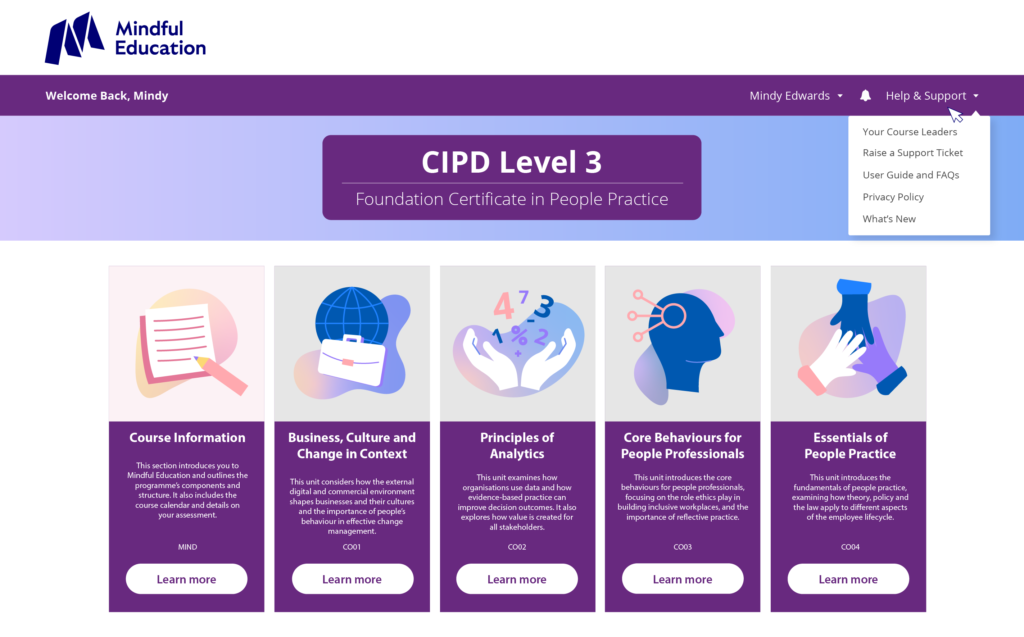
Find out more about our Online and On Campus apprenticeships →
Driving social mobility in the workplace
By their very nature, apprenticeships are arguably the most inclusive way to upskill a workforce, allowing people to start their careers or retrain without the associated costs of funding their own training. Hybrid apprenticeship delivery takes this a step further, giving learners the flexibility to study around their work commitments. Enhanced by assistive technologies such as video subtitles and transcripts, these factors support employers to drive social mobility and build a diverse, inclusive workforce.

Reinforcing operational efficiency
For a talent strategy to be truly ‘future ready’, it must align with the natural cycles of a business – whether that’s the end of the tax year for accounting teams, or peak recruitment seasons for HR.
Traditional academic calendars, with rigid September start dates, often act as a barrier to entry. Seeking a provider that offers a roll-on, roll-off training model allows businesses to onboard an apprentice when the need arises. This agility ensures that their growth and skills levy payments – which from 1 August 2026 will expire after one year – are working for them year round, rather than sitting dormant.
What’s changing in August 2026?
From 1 August 2026, the financial rules governing the growth and skills levy will shift, including:
- Halved fund expiry window: the lifespan of any new funds entering a Digital Apprenticeship Service (DAS) from 1 August 2026 will be reduced from 24 months to 12 months, after which funds are reclaimed by the treasury. This ‘use it or lose it’ policy requires proactive, annual planning to maximise payments.
- Removal of 10% government top up: the automatic monthly 10% uplift previously added to levy contributions will be withdrawn.
- Increase in co-investment costs: for organisations who exhaust their levy funds, the employer contribution for additional training will rise from 5% to 25%.
Source: https://find-employer-schemes.education.gov.uk/interim/growth-and-skills-levy
A common hurdle for employers is the perceived complexity of off-the-job training compliance. HR leaders often fear that training hours will disrupt core operations or create an administrative burden. Hybrid apprenticeships address this problem by integrating learning into the flow of work.
Mindful Education’s real-time learner analytics provide tutors with immediate insights into learner progress and engagement. This data-driven transparency provides:
- Audit readiness for levy funding requirements
- Performance monitoring, enabling early intervention if a learner starts to fall behind
- Operational continuity, with the ability to plan around a learner’s work schedule, ensuring that their development contributes to workforce productivity
- Engagement insights, highlighting the most engaged and capable apprentices who are best placed for promotion
Creating a thriving, adaptable workforce
Embracing a modern approach to apprenticeships is essential to create a thriving, inclusive and adaptable workforce. By moving away from a ‘hire in’ approach to a ‘grow your own’ model, businesses can create a sustainable talent pipeline that flows from entry-level through to senior management.
The transition to hybrid apprenticeship delivery – combining the flexibility of online learning with collaborative on campus sessions – can effectively drive ROI while building a workforce that is truly ready to meet future challenges and opportunities.
Next steps for your talent strategy
If your business is looking to audit your current training strategy or explore how hybrid apprenticeships can bridge your organisation’s skills gaps, the Mindful Education Employer Engagement team can discuss how a structured, professional apprenticeships strategy can support your talent goals.
Contact apprenticeships@mindful-education.co.uk to arrange a meeting.
Katherine McKenna
Head of Employer Engagement
Katherine leads on promoting our award-winning, professional apprenticeships to employers across the UK and works closely with our partners on joint employer outreach and sales initiatives.